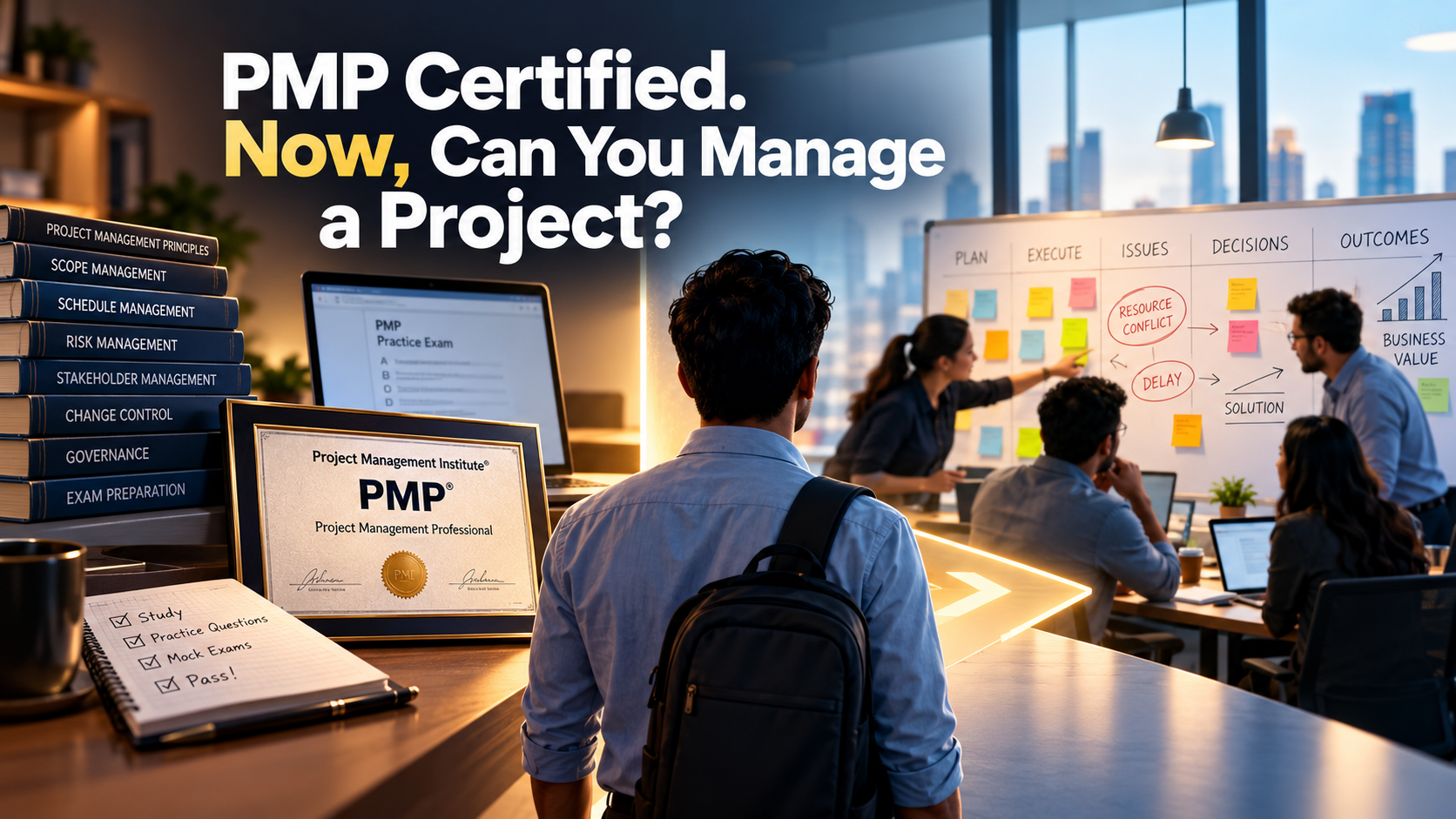
Passing the exam is an achievement. Learning to manage a project is a different journey.
So, you have just cleared your PMP examination. Spent weeks, perhaps months, studying project-management concepts, working through practice questions and learning the terminology. You understand how projects should be planned, how risks should be assessed and how stakeholders should be managed. You now have a recognised professional certification to show for your effort.
Now, it’s time to manage a real project.
The plan is ready, and the responsibilities have been assigned. Within a few weeks, a critical milestone begins to slip. A functional manager withdraws a resource you were counting on. A stakeholder changes a requirement that everyone had previously agreed upon. The sponsor wants the original deadline maintained, but nobody is willing to make the decisions necessary to recover the schedule.
You know the processes. You understand the tools. But what do you actually do?
Apparently, there is a difference between learning project management and practising project management.
The PMP certification is a valuable achievement. It provides a structured understanding of the discipline, its principles and the techniques available to manage projects. Yet passing an examination and taking responsibility for a live project are two different experiences.
One demonstrates your knowledge of project management. The other requires you to apply that knowledge in situations involving incomplete information, competing priorities, difficult conversations and decisions that rarely have a single textbook answer.
What does certification give you?
Project management is a discipline, not simply an activity that people learn by watching others. It has established principles, methods and practices that help us define objectives, plan work, manage dependencies, assess risks, engage stakeholders and monitor progress.
Structured learning introduces you to these practices and provides a common professional language. It helps you understand how the different aspects of project management fit together. It also gives you a starting point when you encounter situations you have not faced before.
Consider someone who has never managed a project. Without a structured foundation, they might assume that preparing a list of activities is equivalent to planning, that sending regular updates is equivalent to stakeholder management, or that recording a risk is sufficient to manage it.
Formal learning helps correct these misunderstandings.
Certification can also demonstrate commitment to professional development and strengthen your professional credibility. For someone entering the field, it can be a useful step towards building a career in project management.
But we need to understand what this achievement represents.
A certification demonstrates that you have met its requirements. It does not, by itself, establish how effectively you will handle a resource conflict, negotiate a difficult commitment, recognise an emerging problem or guide a team through uncertainty.
And that is not a weakness of the PMP. No examination can reproduce every situation a project manager will encounter.
The real opportunity is to take the knowledge you have acquired and develop the capability to apply it. I find it typically useful to think about that development through four questions:
- WHAT do I need to know?
- WHY does it matter?
- HOW do I apply it?
- What VALUE are we trying to create?
Together, these questions provide a practical way to think about the journey from learning project management to practising it.
1. WHAT: Know the discipline
The first step is to understand the tools, techniques and principles available to you. The fundamental questions are:
- Can you define the scope of a project?
- Can you build a schedule and identify dependencies?
- Can you distinguish a risk from an issue?
- Do you understand how to assess stakeholders, manage changes and establish governance?
- Can you identify the information needed to monitor progress?
Imagine you are asked to manage the implementation of a new software platform. You need to identify the deliverables, sequence the activities, understand the dependencies, allocate resources and establish milestones. Without this foundation, you might start coordinating meetings and collecting updates without having a clear picture of how the work fits together.
Knowing the discipline gives you a structured way to approach the assignment.
You can identify what needs to be planned, what must be monitored and which management practices are relevant. You have a set of tools to draw upon rather than having to invent an approach from scratch.
But knowing what to do is only the beginning.
A project plan can be technically correct and still be unrealistic. A risk register can be complete and still fail to identify the problem that eventually disrupts delivery. A stakeholder map can be well prepared without telling you how to resolve a disagreement between two influential stakeholders.
The tools are necessary, but their usefulness depends on how they are applied.
The first test of a project manager is whether they know the discipline. The next is whether they understand its purpose.
2. WHY: Understand the purpose behind the tools
This is where knowledge starts becoming understanding.
Take the project schedule. You know how to sequence activities, establish milestones and identify the critical path. But why do you do these things?
The purpose is not to produce a Gantt chart for a steering committee presentation. It is to understand how the work must unfold, where dependencies exist, which delays matter and what options are available when the plan changes.
Once you understand the purpose, you begin to look at the schedule differently.
You ask whether the assumptions behind the estimates are realistic. You check whether the resources are genuinely available. You examine whether the sequence reflects operational realities. You consider whether decisions can be made quickly enough to support the planned dates.
Why do we maintain a risk register?
Not because the governance process requires one, but because uncertainty can affect our ability to achieve the project objectives. Identifying risks gives us an opportunity to anticipate problems, prepare responses and make informed decisions before the consequences become more difficult to manage. If a risk is documented but nobody acts on it, the administrative task may be complete while the management purpose remains unfulfilled.
Understanding the purpose also helps you decide which tools deserve the most attention in a particular situation.
A small, straightforward project may not require the same level of planning and governance as a complex programme involving multiple vendors and business units.
Applying every possible technique with equal intensity can create unnecessary overhead. Applying too little discipline can leave important dependencies and risks unmanaged. The practitioner understands what the tools are intended to accomplish and adapts their use to the needs of the project.
This is an important development in your thinking.
You stop asking only whether a process has been followed and start asking whether it is helping you manage the project effectively.
3. HOW: Exercise judgement in the real world
Ability to judge the situation with project encounters difficulty is perhaps a more important ability for a project manager.
Let’s consider a project that is falling behind schedule because a critical resource has been reassigned to another business priority. You have identified the delay, updated the forecast and assessed its impact. You know how to report the issue and escalate it through the appropriate governance structure.
But what should happen next?
- You could ask the sponsor to intervene.
- You could negotiate with the functional manager.
- You could explore whether the work can be resequenced.
- You could reduce the scope of an interim deliverable or revise the milestone.
Each option has consequences.
Escalation may secure the resource, but it could damage a working relationship if the underlying priority conflict has not been understood. Resequencing may protect the immediate milestone but create a dependency problem later. Reducing scope may be sensible, provided the essential outcome is preserved.
There is no single response that is always correct.
The project manager must understand the circumstances, assess the alternatives and decide what is most appropriate.
That is practitioner judgement, where the human side of project management becomes particularly important.
Projects are delivered through people who have their own responsibilities, incentives and constraints.
A project manager must often influence people who do not report to them, resolve disagreements between functions and secure decisions from stakeholders with competing interests.
Knowing the escalation process does not automatically teach you when to escalate. Knowing the principles of stakeholder management does not automatically help you handle a stakeholder who repeatedly agrees in meetings but fails to deliver. These capabilities develop through practice, feedback and reflection. The aim is not to abandon formal methods and rely on instinct. It is to combine knowledge with an understanding of the situation.
Judgement is not a substitute for project-management knowledge. It is what allows you to apply that knowledge intelligently.
4. VALUE: Connect the work to the reason the project exists
There is one more question that a project manager must learn to ask.
What are we ultimately trying to achieve?
Projects are often discussed in terms of scope, schedule, budget and deliverables. These are important dimensions of performance, but they are not always the reason the project was initiated.
A company might implement a new customer-service platform to improve customer experience and reduce service costs. The platform may be delivered on time and within budget, yet adoption among service agents remains low. Customers continue to experience delays, and the expected cost savings do not materialise.
From a delivery perspective, the project may have completed its planned scope.
From a business perspective, the intended outcome remains unrealized.
This distinction matters because the project manager needs to understand what the deliverables are intended to enable.
That does not mean the project manager personally owns every business outcome. Benefits may depend on operational adoption, decisions made by business leaders and conditions outside the project’s control.
It does mean the project manager should understand the intended outcomes, recognise when delivery assumptions are threatened and help the organisation respond.
For example, if adoption is essential to achieving the expected benefits, the project plan should account for training, readiness, operational ownership and the transition into business-as-usual activities. These should not be treated as afterthoughts once the technical implementation is complete.
The question changes from “Have we delivered what we planned?” to “Have we delivered what is needed to achieve the intended result, and what remains to be done?”. This is a more complete view of project management.
It connects the discipline to its purpose without suggesting that every project manager has direct control over the eventual business benefits.
And it gives the practitioner a reason to look beyond the immediate task list.
How do you develop these capabilities?
The progression from WHAT to WHY to HOW to VALUE is not a formal sequence in which one stage ends before another begins. You will move between these questions throughout your career. The important thing is to develop deliberately rather than assume that capability will automatically follow certification or years of experience.
- Start by applying what you have learned – Look for opportunities to take responsibility for a workstream, a project milestone or a small cross-functional initiative. You don’t need to begin with a large programme. What matters is that you move beyond observing project management and begin making decisions about real work.
- Ask experienced practitioners why they do things a particular way – When an experienced project manager escalates an issue, challenges a deadline or changes the approach, ask what informed the decision. Understanding the reasoning behind an action is often more valuable than copying the action itself.
- Reflect on the decisions you make – After a milestone or project, consider what surprised you, which assumptions proved incorrect and where you could have acted earlier. If something went wrong, look beyond the immediate explanation. Was the underlying issue visible earlier? Did the team have the information it needed? Was a decision delayed? Would a different approach have produced a better result?
- Build the skills that help you work with people – Communication, negotiation, facilitation, conflict management and decision-making are not optional extras. They are essential to applying project-management knowledge in a real organisation. Practise having difficult conversations, making trade-offs explicit and securing genuine commitments.
- Keep Learning – Read about projects beyond your own experience. Learn from successes and failures. Seek feedback. Develop your understanding of different delivery approaches and keep your professional knowledge current.
Experience becomes valuable when you examine it and learn from it. Without reflection, it is possible to repeat the same mistakes for years. With deliberate learning, even a relatively small assignment can teach you something that improves your next project.
A useful personal review after each significant milestone is to ask:
- What did I know going into this situation?
- Did I understand why the issue mattered?
- How did I respond, and what alternatives did I consider?
- What effect did my decision have on delivery and the intended outcome?
- What will I do differently next time?
These questions turn project experience into a continuing development process.
The real milestone
Early in a project-management career, it is natural to focus on completing activities, following processes and keeping the plan updated. As you gain experience, you begin to see the connections between those activities, the decisions that influence them and the people whose cooperation is essential.
You learn that a plan is only as credible as its assumptions. A risk register is useful when it informs action. A stakeholder meeting matters when it helps resolve a problem or secure a commitment. A completed deliverable matters because of what it enables the organisation to do.
Over time, you begin to see project management as more than a collection of tools and processes. You see it as a discipline for bringing people, decisions and work together to achieve an objective.
That development takes time, and there is no reason to wait until you have accumulated a particular number of years before beginning it. You can start with your first project by being curious, seeking feedback and taking responsibility for learning from the decisions you make.
If you are preparing for your PMP, pursue it with confidence. Learn the discipline, understand the tools and take pride in the achievement.
Then take the next step. Find opportunities to apply what you have learned. Build your judgement. Learn how to navigate the realities of delivery. Keep connecting your work to the reason the project exists.
Passing the PMP exam demonstrates that you have learned the discipline. Becoming a project manager means learning to practise it.
The certificate can open a door. What you learn by walking through it is what will shape you as a practitioner.
Leave a Reply