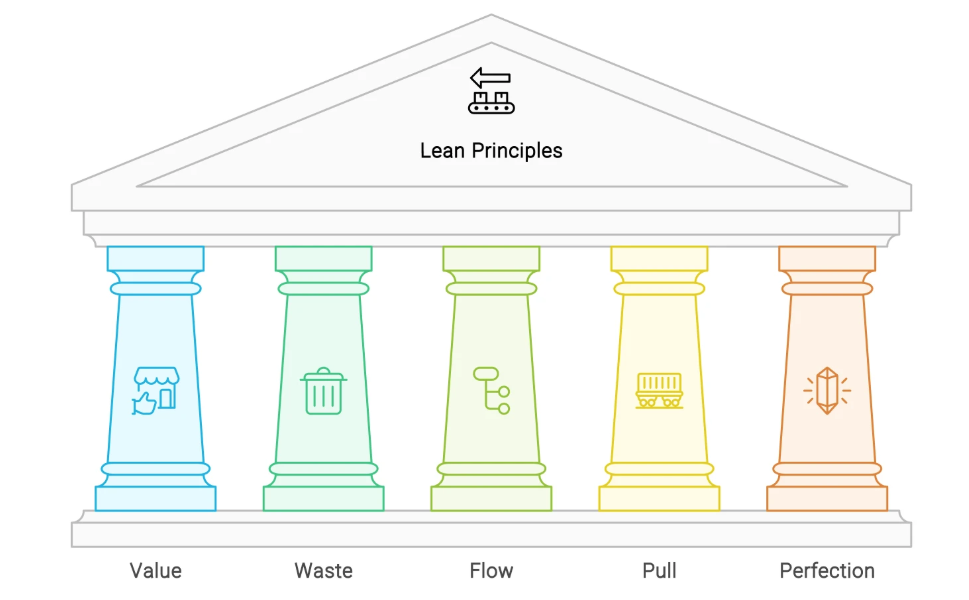
Removing waste between Business Ambition and Business Value
Over the years, Lean Manufacturing has helped organisations reduce waste, improve flow, eliminate unnecessary steps and continuously improve how work gets done.
It made me wonder:
What if we applied the same thinking to strategy?
Not to make strategy simplistic. Not to make it faster for the sake of being faster. But to ask a fundamental question:
How much waste exists between a company’s business ambition and the business value it ultimately realizes?
Lean thinking challenged organisations to look at the entire flow of work differently. Every unnecessary step consumes resources without creating additional value.
What if we Identify what creates value for the customer, and remove everything that doesn’t.
Strategy has waste too
We don’t usually think of strategy in terms of waste. But look at what happens in many organisations:
- Months of analysis
- Multiple workshops
- Long strategy documents
- Leadership presentations
- Reviews and approvals
- Dozens of strategic priorities
- Hundreds of initiatives
- Annual planning cycles
- Quarterly reviews
- Dashboards and governance forums
None of these are inherently bad. In fact, most exist for good reasons. But there is a point worth asking: How much of this actually moves the organisation closer to the value it is trying to create?
An organisation can spend enormous amounts of leadership time, money and energy on strategy, and still struggle to translate it into business outcomes.
That, to me, is strategic waste.
What could Lean Strategy mean?
I believe it starts with a simple idea: Make the journey from Business Ambition to Business Value as direct as possible.
That means being clear about:
- What value are we trying to create?
- What actually drives that value?
- Where is value being lost?
- Which interventions will make the biggest difference?
- What needs to happen for that value to be realised?
It is less about producing more strategy. It is about ensuring that the strategy-design, strategy-implementation, and strategy-execution effort is focused on what matters.
Strategic waste isn’t always obvious
Consider a manufacturing company looking to improve profitability. It launches initiatives across procurement, logistics, workforce productivity, energy consumption and overheads. All of them sound sensible.
But suppose the analysis shows that a few production bottlenecks are responsible for a disproportionate share of the margin opportunity. The organisation could spend months managing dozens of initiatives when a handful of interventions could create most of the value. The problem isn’t that the initiatives are wrong.
The problem is that the organisation hasn’t focused its energy on the value drivers that matter most.
Or, take a SaaS business trying to accelerate growth. Marketing spend increases. The sales team expands. Leads are growing. But customer retention is deteriorating. The organisation keeps putting more effort into acquiring customers while losing value further down the customer lifecycle.
The answer may be hidden in fixing the retention.
Or, consider a retailer investing heavily in an omnichannel transformation. New digital capabilities are delivered. New customer journeys are designed. The programme is declared successful. But customers aren’t adopting the new journeys at the expected rate.
The technology has been delivered. The value hasn’t.
And, then there is the hospital that wants to increase capacity. The obvious answer might be to add beds. But what if the real constraint is operating theatre utilisation or specialist availability? More beds won’t necessarily create more value. The issue is not the ambition.
It is understanding what actually drives the value.
Lean doesn’t mean doing less. It means wasting less.
This distinction is important.
A lean strategy is where there is greater clarity about what matters and greater discipline about what doesn’t. It means being willing to ask:
- Do we really need this analysis?
- Does this decision need another layer of approval?
- Why do we have 40 strategic initiatives when six could potentially drive most of the value?
- Are we measuring activity or outcomes?
- Are we continuing to fund something because it is strategically important — or because we have already invested too much in it?
And perhaps the most difficult question:
What should we stop doing?
In manufacturing, eliminating waste frees up capacity. In strategy, eliminating strategic waste can free up something equally valuable:
Leadership attention and organisational capacity.
The real issue is the distance between ambition and value
A business may have a perfectly sensible ambition. It may have the right strategy. It may have the right investments. And yet, the expected value may still not materialise. There can be leakage at every stage.
- Between strategy and prioritisation
- Between prioritisation and investment
- Between investment and implementation
- Between implementation and adoption
- Between adoption and business outcomes
This is why I see Lean Strategy as a way of thinking about the entire journey from ambition to value.
Business Ambition --> Business Value --> Value Drivers --> Value Leakage --> Focused Intervention --> Execution --> Value Realization
What does this mean for TwoBees?
This way of thinking is closely connected to what we are building at TwoBees.
We don’t believe organisations necessarily need more strategy. They need strategy that is closer to value. That means starting with the value the business is trying to create.
- Understanding the drivers behind that value
- Identifying where value is leaking
- Focusing the organisation on the interventions that matter
- And, staying connected to whether the intended value is actually being realised.
For us, Lean Strategy is therefore about removing the unnecessary distance between Business Ambition and Business Value.
And perhaps that is the real lesson we can take from Lean Manufacturing.
- In a factory, every unnecessary step consumes time, capacity and resources
- In a business, every unnecessary strategic activity does the same.
The difference is that strategic waste is much harder to see.
Maybe it is time we started looking for it.
Want to explore how?
At TwoBees, we are working on a practical approach to help organisations identify strategic waste, focus on the value drivers that matter, address value leakage and improve the flow from ambition to realised business value.
If this is a challenge you recognise in your organisation, I’d be happy to have a conversation.
Leave a Reply