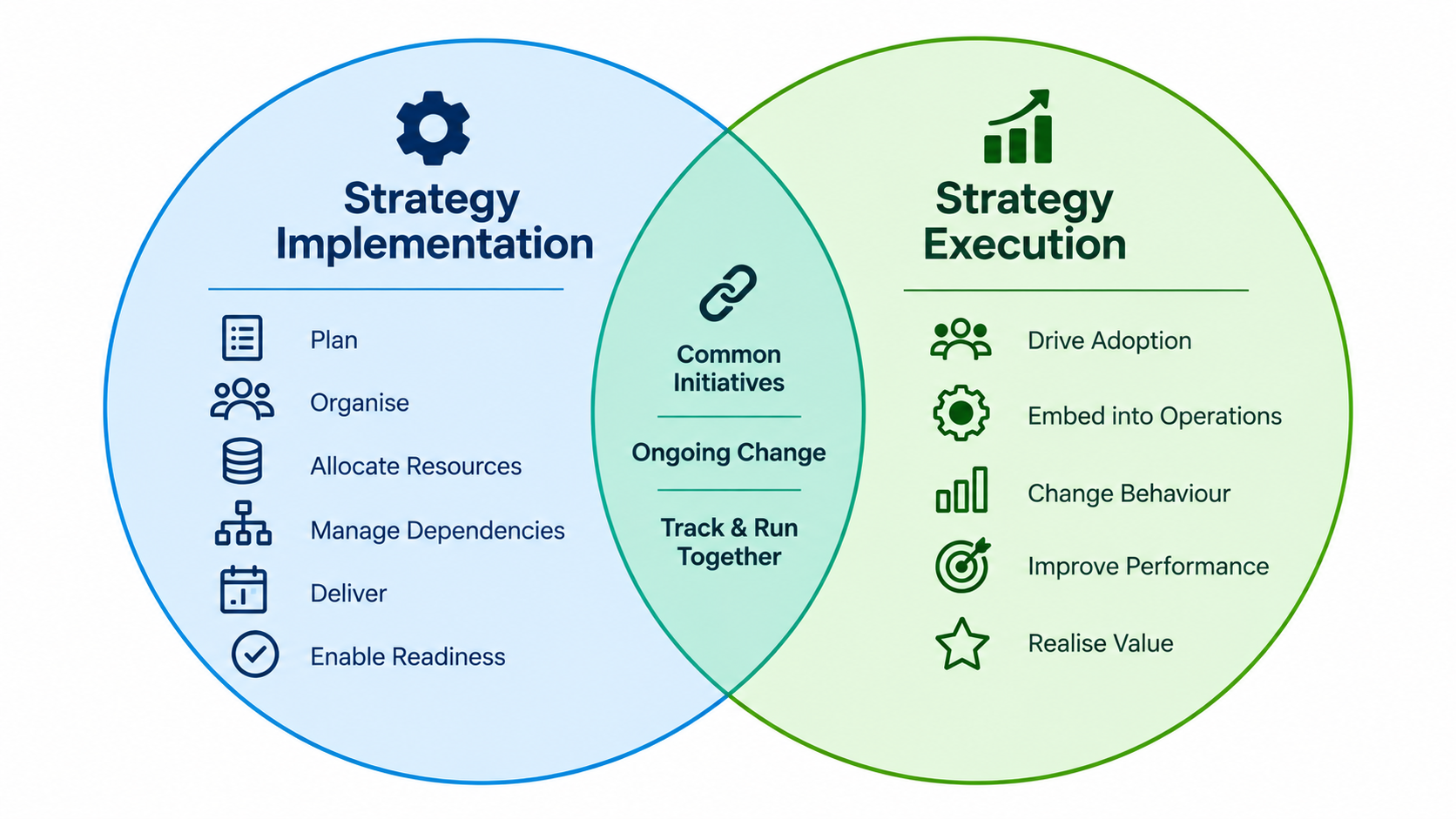
I was recently part of a discussion at an event where an interesting question came up: Is there a difference between Strategy Implementation and Strategy Execution?
At first, it sounds like a question of semantics. Both are about taking strategy into action. Both involve people, processes, investments, timelines and outcomes. And in most organisations, the two terms are often used interchangeably. But, the more I have worked with organisations, the more clearer I saw the distinction between the two. And that distinction matters.
Because, when implementation and execution get treated as the same thing, it becomes difficult to know what has actually been delivered, what is still changing, and whether the intended business value is really being created.
Strategy doesn’t become reality in one step
A strategic decision made by leadership has to travel quite a distance before it becomes a business outcome. For example, a company may decide:
“We will build a new digital sales channel to increase revenue.”
That decision creates a set of implementation questions.
- What needs to be built?
- Who owns it?
- What are the milestones?
- What technology is required?
- What budget is needed?
- What dependencies exist?
- What needs to be changed in processes?
- What needs to be ready before launch?
These are fundamentally project management questions. And this is where I see Strategy Implementation beginning.
Implementation is about making the strategy executable
I believe Strategy Implementation as the process of translating strategic intent into a structured set of initiatives that can be delivered. It is about turning:
“This is what we want to achieve”
into:
“This is what needs to be done, by whom, by when, with what resources and dependencies.”
Project management principles become extremely relevant here.
- Clear scope.
- Defined deliverables.
- Milestones.
- Ownership.
- Resources.
- Dependencies.
- Risks.
- Governance.
- Decision rights.
A well-designed implementation system creates the conditions for the strategy to actually move. But that is not yet execution.
Then comes Strategy Execution
Execution begins when the organisation starts using, adopting and operating what has been implemented to produce the intended business outcomes. So let’s say, the digital sales channel has been built.
- But are customers using it?
- Are sales teams actually adopting it?
- Is conversion improving?
- Is revenue increasing?
- Are customers behaving differently?
- Is the economics of the channel working?
The project may have been delivered successfully. The strategy may still not be delivering. This is the distinction I believe is key:
Implementation makes the strategy executable. Execution makes the strategy work.
And here is where it gets complicated
Even if the distinction is clear, implementation and execution are not two neatly separated boxes. There is an inherent overlap.
- A technology platform may still be undergoing implementation while business teams are already beginning to use it.
- A new operating model may be designed and rolled out in phases while teams are simultaneously adapting to it.
- A new sales process may be implemented in one market while execution is already being measured in another.
So we have something that looks more like this:
Strategy → Implementation → Execution → Business Outcomes
The two streams interact. And, this is where tracking becomes difficult.
A project team may say:
“The initiative is 90% complete.”
The business leader may say:
“But we aren’t seeing the expected results.”
Both can be right.
The implementation may be progressing exactly as planned. The execution may still be falling short.
Project management helps. But we need Execution Management as well.
Here is where the principles of project management have an important role to play in Strategy Implementation. A good project management discipline gives us visibility into:
- What needs to be delivered
- Who owns it
- When it needs to happen
- What dependencies exist
- What risks are emerging
- What decisions are pending
- Whether milestones are being achieved
But a project dashboard cannot, by itself, tell us whether the business has realised the intended value. That requires a different set of questions.
- Are people adopting the change?
- Are processes actually behaving differently?
- Are customers responding differently?
- Are the operational metrics moving?
- Are the financial outcomes emerging?
- Is the value hypothesis holding true?
That is Execution Management.
The danger of confusing activity with outcomes
This is perhaps one of the biggest challenges in strategy execution. Organisations are often very good at tracking activity.
- 95% of the technology is implemented.
- 87% of employees have been trained.
- The new process has been rolled out to 80% of locations.
- All programme milestones are on track.
These are useful measures. But they don’t necessarily tell us whether the strategy is working. Because the ultimate question is not:
“Did we complete the initiative?”
It is:
“Did the initiative create the change and business value we expected?”
That is a very different measure.
So what should be tracked?
I believe we need to look at the two dimensions separately while recognising their overlap.
Implementation tracking – Are we building and delivering what the strategy requires?
Scope → Deliverables → Milestones → Dependencies → Resources → Risks → Readiness
Execution tracking – Is the organisation using what has been implemented to create the intended outcome?
Adoption → Behaviour → Operational performance → Business KPIs → Value realization
The first tells us whether the change is being delivered. The second tells us whether the change is working. And both need to be visible at the same time.
This is where I see a gap
Many organisations have strong project management. They have PMOs, Programme dashboards, Steering committees, RAID logs, Milestone tracking, and Governance structures. Yet they can still struggle to answer a deceptively simple question:
“We are implementing the strategy, but are we actually achieving it?”
The problem isn’t necessarily a lack of tracking. It is that implementation tracking and execution tracking are often mixed together. Once they are separated conceptually, the conversation becomes much clearer. We can ask:
- Is the initiative being delivered?
- Is the organisation adopting it?
- Is performance changing?
- Is value being realised?
Each question requires a different lens.
The TwoBees perspective
This distinction is an important part of how we think about strategy at TwoBees. We don’t see Strategy Implementation and Strategy Execution as competing definitions. We see them as two connected but distinct management disciplines.
Strategy Implementation – makes the strategic intent executable.
Strategy Execution – turns that implemented change into sustained business performance and value.
And because the two overlap, they need to be managed as connected streams rather than treated as one undifferentiated programme. The important part is that we don’t lose sight of the value while managing the implementation. Nor do we assume that successful implementation automatically means successful execution.
Perhaps the better question isn’t “Implementation or Execution?”
It is:
“What needs to be implemented, what needs to be executed, and how do we know when the intended value is actually being realised?”
That distinction may sound subtle. In practice, it can make a significant difference. Because strategy doesn’t fail only because organisations cannot execute. Sometimes, we haven’t clearly separated what needs to be implemented from what needs to change through execution.
And when that happens, the organisation can become very good at delivering initiatives without necessarily delivering outcomes. That is the distinction I believe leaders need to see clearly. And it is an area where we at TwoBees are working to bring greater clarity, discipline and value focus to the journey from Strategy to Results.
Leave a Reply